
Updated: as of 19 October 2026. GRAP orders change through the season. Always check the stage in force on the CAQM website before planning work. This article is general guidance, not legal advice.
Every winter, developers in Delhi NCR plan around the same question: will the excavation, piling and muck haulage on site be allowed to continue next week? The answer comes from the Graded Response Action Plan (GRAP), issued and enforced by the Commission for Air Quality Management in NCR and Adjoining Areas (CAQM). If you are planning a basement or bulk earthwork package this season, this is what GRAP means in practice.
What GRAP is and how stages are invoked
GRAP classifies air quality in Delhi into four stages: Stage I "Poor" (AQI 201–300), Stage II "Very Poor" (AQI 301–400), Stage III "Severe" (AQI 401–450) and Stage IV "Severe+" (AQI above 450). Restrictions are cumulative: when Stage III is invoked, the Stage I and II actions continue as well.
Stages are invoked in advance, based on IMD / IITM forecasts, not only after the AQI crosses a threshold. A site can therefore get a day or two of notice, or none at all if an episode comes suddenly. The current schedule is the revised GRAP schedule dated 29.09.2026, summarised in the PIB release of 29 September 2026.
Stage by stage: what it means for an excavation site
| Stage | What it means for earthwork, piling and haulage |
|---|---|
| I – Poor | Dust-mitigation rules must be followed: covered storage, covered vehicles, water sprinkling, anti-smog guns as required. C&D projects on plots of 500 sqm or more that are not registered on the state / GNCTD dust-monitoring web portal are not permitted to work. |
| II – Very Poor | Inspections of dust-control measures at C&D sites are intensified. Work continues, but non-compliance is more likely to be caught. |
| III – Severe | Strict restrictions across NCR on earthwork for excavation and filling (including boring and drilling), piling, all demolition, open-trench utility work, RMC batching plant operation, road construction, loading/unloading of dust-generating materials and vehicles carrying construction material or C&D waste on unpaved roads. |
| IV – Severe+ | The Stage III construction ban is extended to linear public projects such as highways, roads, flyovers, pipelines and power transmission. |
Stage III exempts certain project categories, subject to strict dust compliance: railway and metro projects, air and inter-state bus terminals, national security and defence projects, hospitals, linear public projects (until Stage IV), sanitation and water supply projects, and ancillary works. A private residential or commercial basement does not normally fall in these categories, so builders should assume Stage III means the dig stops.
Rules that apply all year, not only in winter
- Portal registration (500 sqm+ plots): registration on the state / GNCTD web portal, video fencing, PM2.5 / PM10 sensors and a self-audit every 15 days. See the DPCC dust-control portal FAQs for Delhi.
- Anti-smog guns in proportion to construction area: at least 1 gun for 5,000–10,000 sqm, 2 for 10,001–15,000 sqm, 3 for 15,001–20,000 sqm and 4 above 20,000 sqm, under CAQM Direction No. 69, as restated in a CAQM advisory.
- Demolition waste (from 1 April 2026): under CAQM Direction No. 97, where demolition precedes construction on plots of 200 sqm or more, demolition waste must be deposited at a designated point and the receipt is checked before CC / OC.
- Basic dust measures: wind barriers on the boundary, dust screens, regular sprinkling or mist, covered materials and debris, and transport only in covered vehicles.
Where the NGT fits in
The National Green Tribunal (NGT) hears environmental cases, and its orders feed into enforcement. The GRAP schedule itself refers to NGT orders in OA 21/2014 (orders dated 04.12.2014 and 28.04.2015) for imposing environmental compensation on violations such as open burning. Pollution control boards also levy compensation on C&D sites that break dust norms. For specific NGT orders, check the NGT website or ask your legal adviser.
How to plan a basement around GRAP
- Front-load the earthwork. The bulk dig, muck haulage and piling are exactly the activities Stage III stops. If you can, start excavation before the October–January season, or plan the programme so the heaviest digging falls outside it.
- Keep float for GRAP days. Add a realistic allowance for lost days to the programme and to the contract, and agree in advance how stoppage days are treated.
- Be compliant before you need to be. Portal registration, sensors, video fencing and anti-smog guns take time to arrange. A site that is not ready can be stopped even at Stage I.
- Plan the restart. When a stage is revoked, the sites that restart fastest have machines, tippers and disposal permissions ready to go.
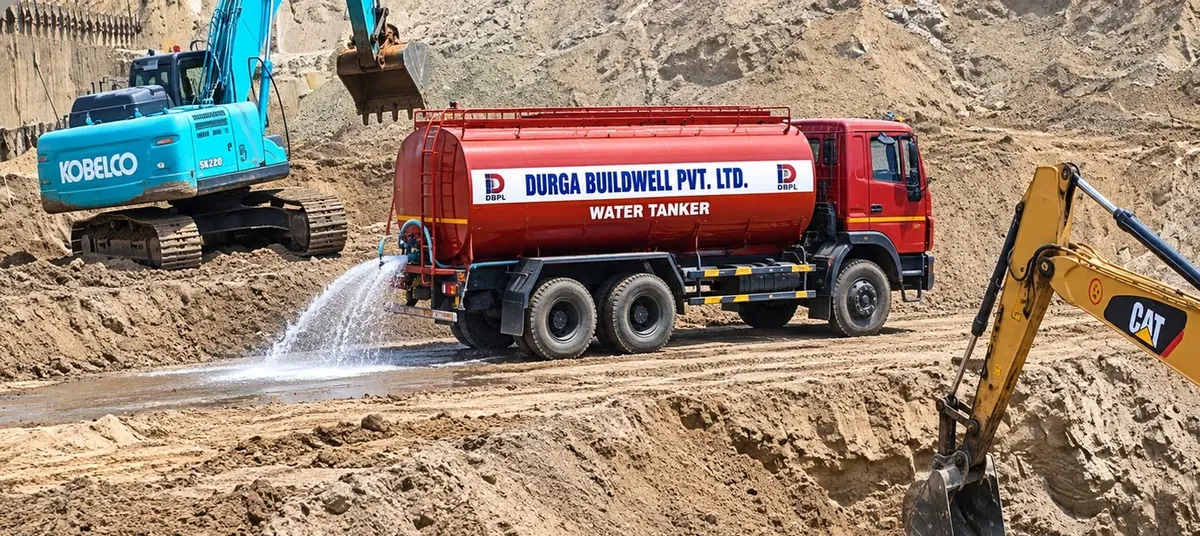
- Watch the haul road. Unpaved haul roads and uncovered tippers are common reasons for penalties. Water tankers on the haul road and covered loads are cheap compared with a closure order.
How we work under GRAP
On our excavation packages, dust control is part of the machine set: our own fleet includes 15+ water tankers that run with the excavators and tippers. We also provide truck-mounted anti-smog gun services; we are L1 (lowest bidder) on a PWD Delhi tender for 10 truck-mounted anti-smog guns on Central & New Delhi roads. When a GRAP stage stops earthwork we follow the directions, and plan the programme with the developer so work can restart quickly once the stage is revoked.
Planning a basement excavation in Noida, Gurugram or Delhi this season? Share your location and start window and we will tell you how we would sequence it around GRAP.
Planning a basement or earthwork package?
Call our office +91 72900 97096 or speak directly to Jeetendra Sharma, Director: +91 98101 66092.
Contact us → or use the enquiry form below.