
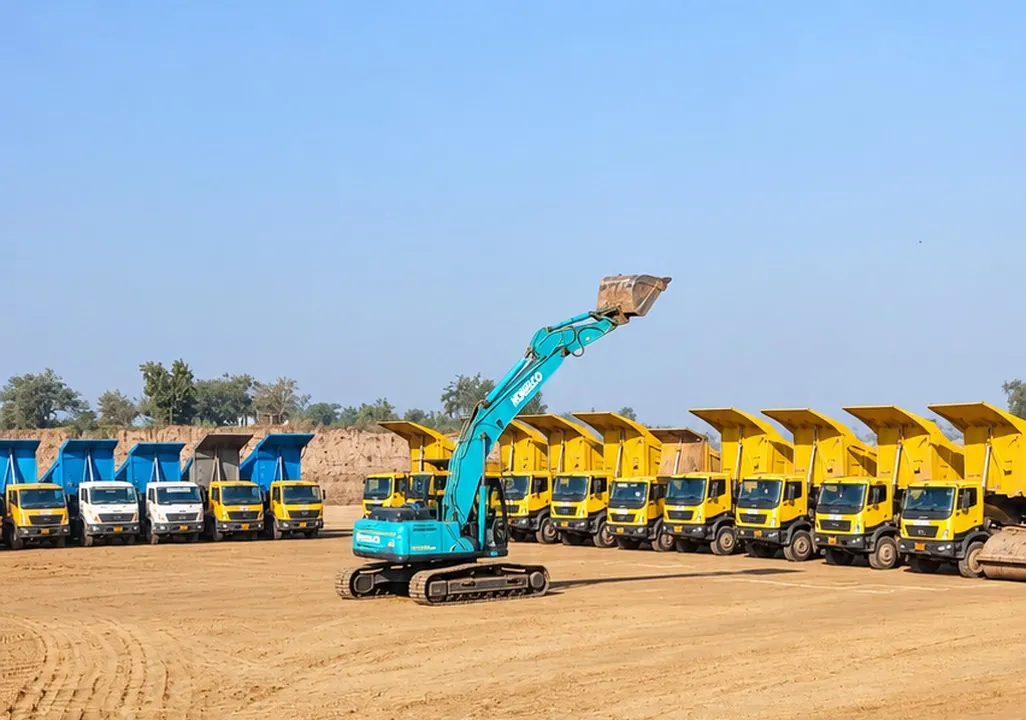
The excavation contractor sets the pace for everything that follows on a basement project. If the dig runs late, the D-wall, piling, raft and structure all move with it, and every month of delay costs interest and overheads. Price matters, but on most NCR projects the more expensive mistake is choosing a contractor who cannot sustain production. Use this checklist before you award the package.
1. Does the contractor own the fleet?
Ask for a fleet list: excavators by class, tippers, graders, rollers and water tankers, and how many are free for your start date. A contractor who hires everything in has less control when the market is busy. As a reference point, our own fleet includes 50+ excavators, 100+ tippers / Hyvas, 50+ graders and rollers and 15+ water tankers.
2. Have they moved comparable quantities?
A 3,000 m³ house basement and a multi-lakh m³ commercial basement are different jobs. Ask for completed and ongoing projects with approximate quantities, and call a reference. Our list includes the Jewar Project (approx. 24 lakh m³ of earthwork), IKEA Gurugram (approx. 9 lakh m³), IKEA Noida (approx. 7.5 lakh m³) and Sobha Rivana (approx. 4.5 lakh m³, ongoing).
3. What is the muck disposal plan?
Disposal often decides the real production rate. Ask where the muck will go, the lead distance, the number of tippers per excavator, the permitted hours for haulage on your route, and who arranges the permissions. A rate that ignores the disposal lead is not a real rate. See muck disposal, levelling and filling.
4. Can they work with your shoring, D-wall and piling?
Deep basements need retaining systems, and the excavation sequence must follow the design. Ask how the contractor coordinates with the D-wall or piling agency, or whether they can take those packages too. One contractor for D-wall, piling and excavation removes an interface. Read our explainer: shoring, piling and D-wall explained.
5. How will they handle dewatering?
Ask how the excavation will be sequenced with your consultant's dewatering design, who runs the pumps and who is responsible if levels change. Plots near river floodplains in Noida, Ghaziabad and parts of Delhi are more likely to need it.
6. Are they ready for GRAP and dust compliance?
Check that they understand portal registration, dust-control requirements and GRAP stoppages, and that they bring water tankers and covered tippers as standard. See our guide to GRAP and NGT rules for excavation.
7. What does safety look like on their sites?
- Full PPE for every worker: helmet, high-visibility vest and safety shoes
- Edge protection and barricading around the pit
- Separate pedestrian and machine routes, banksmen for reversing tippers
- Ramp and haul road maintenance
- Daily toolbox talks and a named safety supervisor
8. How will quantities be measured and billed?
Agree the measurement method before the first bucket: joint initial levels, cross-sections, and whether billing is per cubic metre of excavation, per trip or per machine-month. Clear measurement avoids the most common disputes at the end of a job.
9. How quickly can they mobilise, and how fast can they scale?
Ask for a realistic mobilisation date and how many additional machines they can add if you need to recover lost days, for example after a GRAP stoppage.
10. Who supervises, and how do you get reports?
Ask who the site in-charge is, how often you get progress reports (daily quantity, machines working, trips), and who you call when something goes wrong.
11. Are they the right size for your project?
A contractor geared for large basements may not suit a small plot, and the reverse is also true. We take basement excavation for builder and developer projects of 2,000 sqm and above, and we say so up front.
12. Is the quote complete?
Compare like with like: disposal lead, dewatering support, haul roads and ramps, dust control, night work, mobilisation and demobilisation. If one quote is much lower, find out what it leaves out.
A simple way to compare bids
Score each bidder from 1 to 5 on the points that matter most for your site, then compare the scores with the prices. A slightly higher rate from a contractor who scores well on fleet, disposal and supervision often costs less over the life of the project.
| Criterion | What a good answer looks like |
|---|---|
| Fleet | A named list of owned machines available on your start date |
| Experience | Comparable quantities with references you can call |
| Disposal | A named disposal point, lead distance and tipper plan |
| Compliance | Portal registration, dust measures and a GRAP plan |
| Safety | Full PPE, barricading, a named safety supervisor |
| Commercials | Clear measurement method and a complete scope |
What to send contractors for a like-for-like quote
- Plot location and area
- Number of basement levels and approximate depth
- Soil investigation report
- Retaining system (D-wall, piles or open cut) and its drawings, if ready
- Planned start date and any working-hour limits on site
- BOQ or the scope you want priced
Red flags
- No fleet list, or "we will arrange machines"
- No comparable project they can name
- A per-m³ rate quoted before seeing the plot, depth or disposal lead
- Workers without PPE in their site photos
- Vague answers on GRAP, permits or measurement
If you are comparing contractors for a project in Noida, Greater Noida, Ghaziabad, Gurugram or Delhi, send us the plot size, depth and start window. We will answer every point on this list for your site.
Planning a basement or earthwork package?
Call our office +91 72900 97096 or speak directly to Jeetendra Sharma, Director: +91 98101 66092.
Contact us → or use the enquiry form below.