
Quantify
In-situ volume from levels and drawings, plus allowance for bulking. Loose muck takes more space than it did in the ground, which affects tipper counts.
Excavated muck has to go somewhere, and low land has to come up to level. We plan both sides of the earth balance: haulage to permitted destinations, and filling compacted in layers to specification.
Every excavation creates surplus earth, and many plots need earth brought in. Treating disposal and filling as one plan, with surplus from cutting reused for filling wherever the specification allows, cuts haulage, cost and permissions. We run both with our own excavators, 100+ tippers / Hyvas, graders, rollers and water tankers.
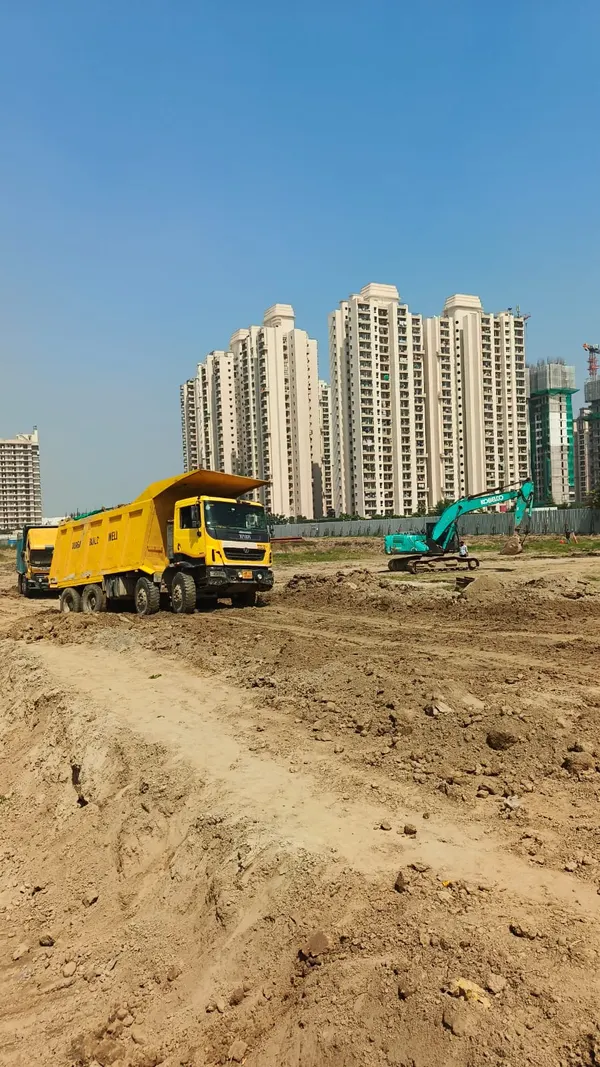
In-situ volume from levels and drawings, plus allowance for bulking. Loose muck takes more space than it did in the ground, which affects tipper counts.
Muck goes only to the destination permitted for the project: a designated disposal or processing point, client-arranged land, or reuse within the project.
Tipper numbers matched to distance, route and permitted hours, with covered loads and clean site exits.
Trip slips or log sheets signed per shift, reconciled against measured excavation.
Disposal permissions and the destination normally stay with the owner or main contractor unless the contract says otherwise. Construction and demolition debris follows the applicable C&D waste rules and local authority directions. For basement-specific planning see basement excavation; for the trucks alone see tipper hire.
Filling that is simply dumped and spread will settle, crack slabs and pond water. We fill in controlled layers, each spread, moistened and compacted before the next.
| Step | What happens |
|---|---|
| Survey | Joint grid levels before work, agreed with the client, to fix the quantity baseline |
| Preparation | Clearing, stripping topsoil or soft material as specified, and temporary drainage |
| Material | Approved fill from site cut or a permitted borrow source, as per the contract |
| Spreading | Grader spreads each lift to the specified loose thickness |
| Moisture | Water tankers bring the soil near optimum moisture |
| Compaction | Rollers compact each lift to the specified density; QA testing as per the client's plan |
| Final grading | Finished levels and slopes for drainage, then a joint survey for measurement |
Our earthwork references include the Jewar Project (approx. 24 lakh m³), IKEA Gurugram (approx. 9 lakh m³) and IKEA Noida (approx. 7.5 lakh m³) of excavation and earthwork.
We raise these points at the start, in the method statement and the BOQ discussion, so they do not become disputes at billing time.


Only to the destination permitted for the project, such as a designated disposal or processing point, client-arranged land, or reuse within the project where the specification allows. The destination and its permissions normally stay with the owner or main contractor.
Excavated earth bulks up. Once loosened it occupies more volume than it did in the ground, so trip counts should be planned on the loose volume, not the in-situ volume.
Often, yes, if it meets the specification for fill. Reusing site-cut material reduces haulage and the need for outside borrow material.
Usually by cubic metre from joint level surveys before and after filling, as per the BOQ. Measuring by trip count is used only where specifically agreed.
Field density testing and acceptance are normally done by the client's QA team or a third-party lab. We place and compact each layer to the specified thickness, moisture and density.
Yes, as part of a demolition or site-clearance scope, with debris taken to permitted destinations as per the applicable C&D waste rules.
Tell us the site location, muck quantity / filling area and depth, start window and whether you are a developer, EPC or main contractor. Attach drawings or BOQ if available. Our business team follows up on qualified enquiries first; for urgent live sites, call us directly.
Tell us the site location, scope (muck quantity / filling area and depth), planned start and whether you are a developer, EPC or main contractor.
507, 5th Floor, Pegasus Tower, Block A-10, Sector 68, Noida, Uttar Pradesh – 201309