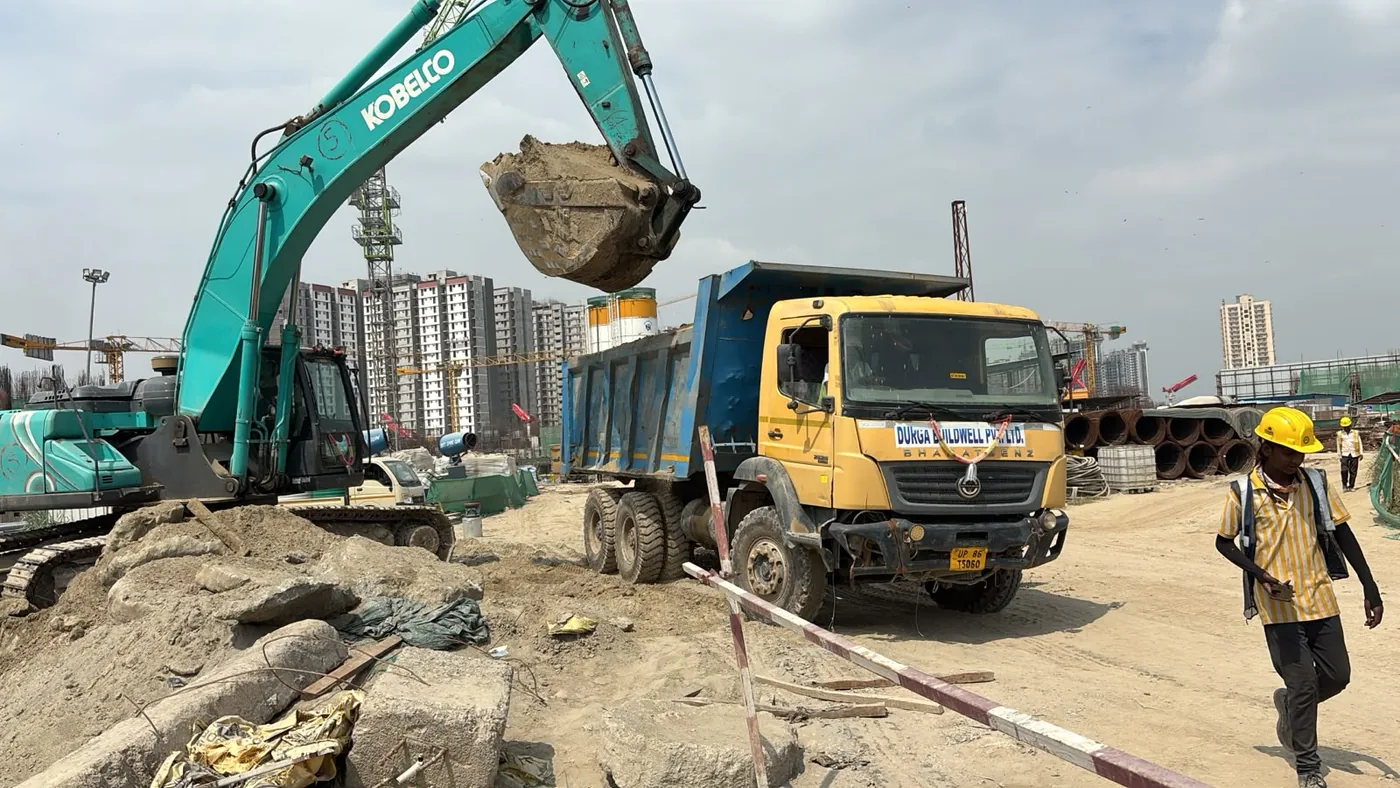
Basement excavation
Staged digging with ramps and benches, coordinated with shoring, D-wall or piling. Basement excavation →
Tracked hydraulic excavators, including the 20–22 tonne class that does most of the digging on NCR sites, deployed with operators from our own fleet of 50+ excavators.
On Indian sites "Poclain" is the everyday word for any tracked hydraulic excavator, after one of the first brands seen in the country. Whatever the nameplate, it is the machine that digs basements, cuts bulk earthwork and loads tippers. It is not the same as a JCB backhoe loader, which is lighter and wheeled.
We run 50+ excavators across our own packages and hire them to developers, EPCs and main contractors. Machines are deployed with operators, as confirmed in the quote, and our operators are used to working beside tippers, shoring and live work fronts.
Sizes below are general industry classes. The exact class and model allocated from our fleet is confirmed in the quote; we do not promise a particular brand.
| Class (operating weight) | Typical machines in this class | Best used for |
|---|---|---|
| Compact, about 7–14 T | Mini and compact excavators | Utility trenches, small plots and tight access, subject to availability |
| Standard, about 20–22 T | PC210 / EX200-class machines | Basement excavation, bulk cutting, loading tippers, ramp and bench work. |
| Heavy, about 30 T and above | Heavy-class excavators | High-volume bulk excavation, hard digging, carrier for heavier breakers, subject to availability |
| Attachments | Bucket types, hydraulic breaker | Hard strata and concrete, deployed as per requirement and availability (see rock breaker) |
Staged digging with ramps and benches, coordinated with shoring, D-wall or piling. Basement excavation →
Loading tippers for disposal or for shifting earth within the site to fill areas.
Sewer, storm-water and utility trenches on townships and industrial plots.
Trimming batters, cutting to formation level and dressing embankments.
The most common reason a hired excavator under-delivers is waiting for trucks. A 20–22 T machine can load a tipper in minutes, but if the dump point is far away through city traffic, it sits idle between loads. Before mobilising we ask for the haul distance, the route and the dump point, and suggest how many tippers keep the excavator working. We can supply both as one matched set.
On deep basements the plan has to account for the ramp, the bench sequence and the retaining system. Our operators work to the excavation sequence your engineer sets, keep clear of struts, anchors and pile caps, and work with a banksman wherever the swing radius crosses people or other machines.
Our excavators have worked on the excavation and earthwork for the Jewar Project (approx. 24 lakh m³), IKEA Gurugram (approx. 9 lakh m³), IKEA Noida (approx. 7.5 lakh m³) and Sobha Rivana (approx. 4.5 lakh m³, ongoing). See projects.


A "Poclain" is a tracked hydraulic excavator: heavier, with more digging depth and bucket capacity, built for basements and bulk excavation. A "JCB" is usually a wheeled backhoe loader: lighter and road-mobile, best for trenches, loading loose material and small jobs.
For most NCR basements the 20–22 tonne class (PC210 / EX200-class) is the workhorse, often with more than one machine working different benches. Very large or hard-digging jobs may justify a heavier class. Share the depth, area and access and we will suggest the set.
Every excavator comes with an operator. Diesel can be supplied by us or by you; the arrangement and how consumption is recorded are confirmed in the quote.
Usually per shift or per month against hour-meter readings and signed log sheets, as confirmed in the quote. If you would rather pay per cubic metre, ask for a measured earthwork package.
Yes, where the project holds the permissions for night work and the site has adequate lighting and supervision. Many NCR sites run double shifts within their permitted hours.
Yes. We run 100+ tippers / Hyvas and can match their number to your haul distance and dump point so the excavator is not left waiting.
Tell us the site location, excavator class, quantity, shift and duration, start window and whether you are a developer, EPC or main contractor. Attach drawings or BOQ if available. Our business team follows up on qualified enquiries first; for urgent live sites, call us directly.
Tell us the site location, scope (excavator class, quantity, shift and duration), planned start and whether you are a developer, EPC or main contractor.
507, 5th Floor, Pegasus Tower, Block A-10, Sector 68, Noida, Uttar Pradesh – 201309